🚴 Cycling
Cycling weather, scored for your ride
Headwinds, wet roads and wind chill on a descent: cycling punishes the weather more than most sports. BlockCast scores every block of your week for riding, with rain and wind both weighted at 8 out of 10, so the long ride lands on the calm dry day.
Free. No account, no ads, no tracking. iPhone, iPad and any web browser.
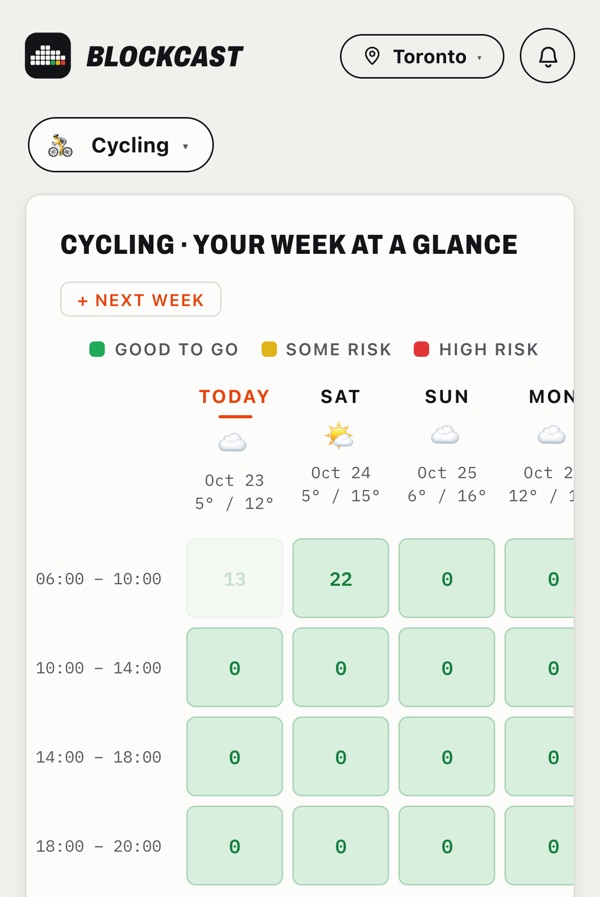
What BlockCast checks for cycling
Every block gets a risk score from 0 to 100: green under 25, yellow under 55, red above. The worst factor drives the score and the others add to it. These are the default weights; you can change any of them in the app under Adjust.
Comfortable feels-like temperature: 5 to 32 °C (41 to 90 °F). Wind adds risk from 20 km/h (12 mph) sustained or 38 km/h (24 mph) in gusts.
How it works
- Pick cycling and your spot. Use your location or search any place in the world, and save up to three.
- Read your week at a glance. Choose 2, 3, 4 or 6 hour blocks and the hours you actually play. Tap any block for the hour-by-hour detail and the reason behind its colour.
- Plan it and stop checking. Add the session to your planner and your calendar. BlockCast re-checks every forecast and tells you if a planned session turns bad.
Cycling weather questions
How windy is too windy for cycling?
Sustained wind above about 25 km/h (15 mph) turns a flat loop into interval training, and gusts above 50 km/h (30 mph) make a road bike hard to hold in a crosswind. BlockCast ramps risk from 20 km/h sustained and from 38 km/h in gusts.
What temperature is too cold to ride?
BlockCast uses feels-like temperature, which includes wind chill, and scores cycling as comfortable between 5 and 32 °C (41 and 90 °F). On a bike you make your own wind, so a cold, breezy morning scores lower than the thermometer suggests.
Does BlockCast tell me wind direction?
Not yet. The scores use wind speed and gusts. Open any block for an hour-by-hour chart of rain and wind, and the radar to see showers coming.
Where the data comes from
Forecasts come from Open-Meteo. Rain is the wettest of three models (the local best match, ECMWF and Canada’s GEM), so a green block means they all agree. Radar is the North American composite from Environment and Climate Change Canada; official alerts come from Environment Canada and the US National Weather Service.